
What drawings and specification information should be prepared before requesting a CNC quote?
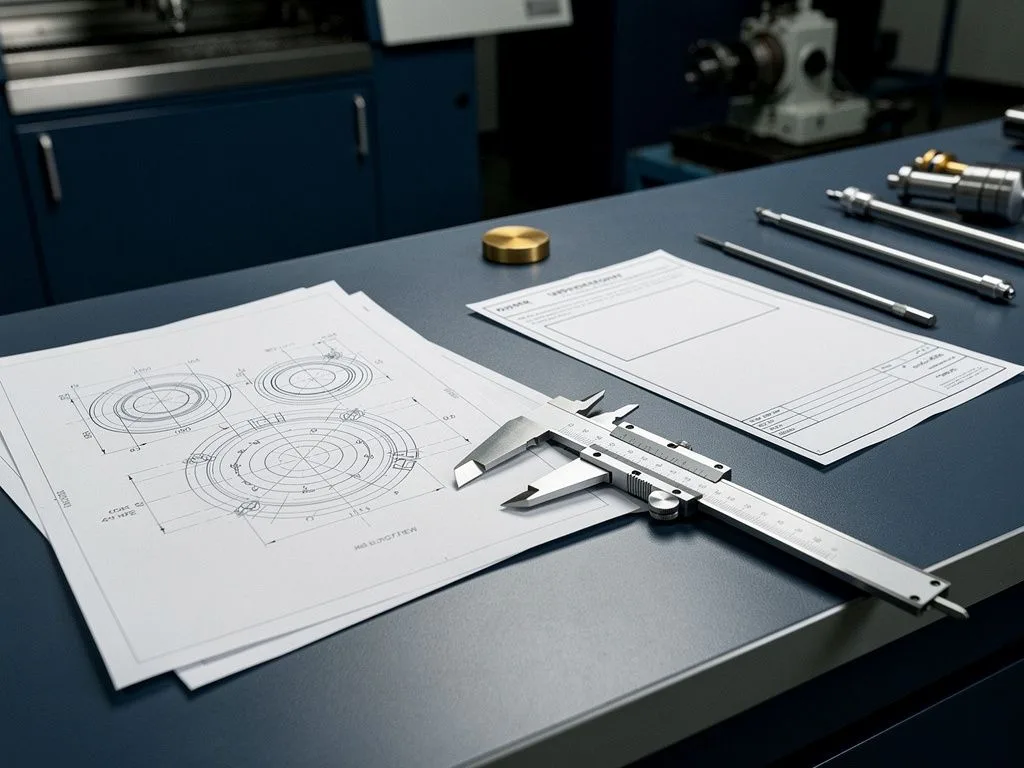
Before requesting a quote from a CNC machining supplier, buyers should prepare at least a 2D engineering drawing, a 3D file (STEP or IGES), specified material, estimated order quantity, key dimensional tolerances, and surface finish requirements. The more complete the drawings and the clearer the specification fields, the more accurately the machining supplier can respond with a quote within 24 to 48 hours, and the less likely disputes will arise during prototyping and mass production due to information gaps. It is recommended that buyers package the drawings, specification sheet, and inspection standards into a single email, as this is the most direct way to shorten the RFQ cycle.
How Does RFQ Information Differ Between Prototyping and Mass Production?
The focus of RFQs differs significantly between the prototyping stage and the mass production stage. For prototyping (1–50 pieces), buyers care most about lead time and machining feasibility. At this stage, the drawing files can be moderately simplified, but it is necessary to note "Prototype parts, possible future mass production" so the machining shop can reserve room for process optimization. For mass production (hundreds of pieces or more), the annual estimated quantity, batch size, delivery cycle, and packaging method should be included, and the machining shop should be asked about its mass production experience and quality control processes, such as incoming inspection, in-process inspection, and final inspection before shipment. For Tier-1 suppliers or OEM buyers, it is also necessary to confirm whether the machining shop understands supply chain documentation requirements such as PPAP and initial sample size reports; these are essential fields in a mass production RFQ. For buyers, the most common blind spot is using the same email to request quotes for both prototyping and mass production, which leads the machining shop to reply with only prototype unit prices, and when mass production begins, the unit price gap is too large and requires renegotiation. It is recommended to clearly separate the two stages in the email and ask the machining shop to quote for each separately, so both parties can have a consensus on the cost of future cooperation. For example, for consumer electronics housings, buyers typically order only 20 pieces during prototyping to confirm appearance and assembly, while mass production may involve orders of several thousand pieces at a time with monthly stable supply requirements. If the buyer does not mention the future mass production plan in the prototype RFQ, the machining shop may quote based on single-piece production, and only later during mass production will it be discovered that new molds, fixture adjustments, and quality control processes are needed, often resulting in a unit price gap that is hard for the buyer to accept. Another example is industrial valve parts: buyers typically order only 10 pieces during prototyping to confirm fluid characteristics, while mass production may involve orders of several hundred pieces at a time with quarterly stable supply requirements. If the buyer does not mention the future mass production plan and annual estimated quantity in the prototype RFQ, the machining shop may quote based on single-piece production, and only later during mass production will it be discovered that CNC programs, fixtures, and quality control processes need to be readjusted, often resulting in a unit price gap that is hard for the buyer to accept.
How should DFM reports and process recommendations be interpreted? What should buyers focus on?
A DFM (Design for Manufacturing) report is a set of manufacturability recommendations that a machine shop provides based on its process experience after receiving the drawings. Buyers should pay particular attention to three key points. First, tool accessibility: the shop will indicate which grooves, internal corners, or deep holes cannot be machined to the design dimensions due to tool diameter limitations. At this point, the buyer needs to assess whether to modify the design or accept looser tolerances. Second, feature simplification recommendations: for example, combining multiple separate holes into a single milling feature, or changing sharp corners to fillets. Such modifications can reduce machining time and tooling costs. Third, compatibility with post-processing and assembly: for example, anodizing changes dimensions, and coating thickness affects tolerance accumulation. The shop will remind the buyer in the DFM to leave allowance. For the buyer, the next step is to compare the DFM report side-by-side with the original drawings, mark each item as "Accept," "Modify," or "Discuss further," and send it back to the shop for confirmation. This way, both parties can minimize the gap between design and process before sampling, avoiding the discovery that mass production is not feasible only after trial parts are made. For example, in the case of an optical instrument housing, if the DFM report states "Internal corner R0.5 must be changed to R1.0 to allow tool access," and the buyer simply makes the change without careful evaluation, it may affect the alignment accuracy of subsequent lens assembly. However, if the buyer notes in the reply that "This R0.5 is a critical dimension for optical alignment and cannot be enlarged," the shop can then evaluate whether to use EDM or special tooling instead. Both parties can reach a consensus before sampling, avoiding a full batch of trial parts being reworked. Similarly, for automotive turbine blades, if the DFM report states "Blade root fillet R0.3 must be changed to R0.5 to allow tool access," and the buyer simply makes the change without careful evaluation, it may affect the assembly clearance between the blade and the hub. However, if the buyer notes in the reply that "This R0.3 is a critical dimension for airflow efficiency and cannot be enlarged," the shop can then evaluate whether to use five-axis machining or special tooling instead. Both parties can reach a consensus before sampling, avoiding a full batch of trial parts being reworked.