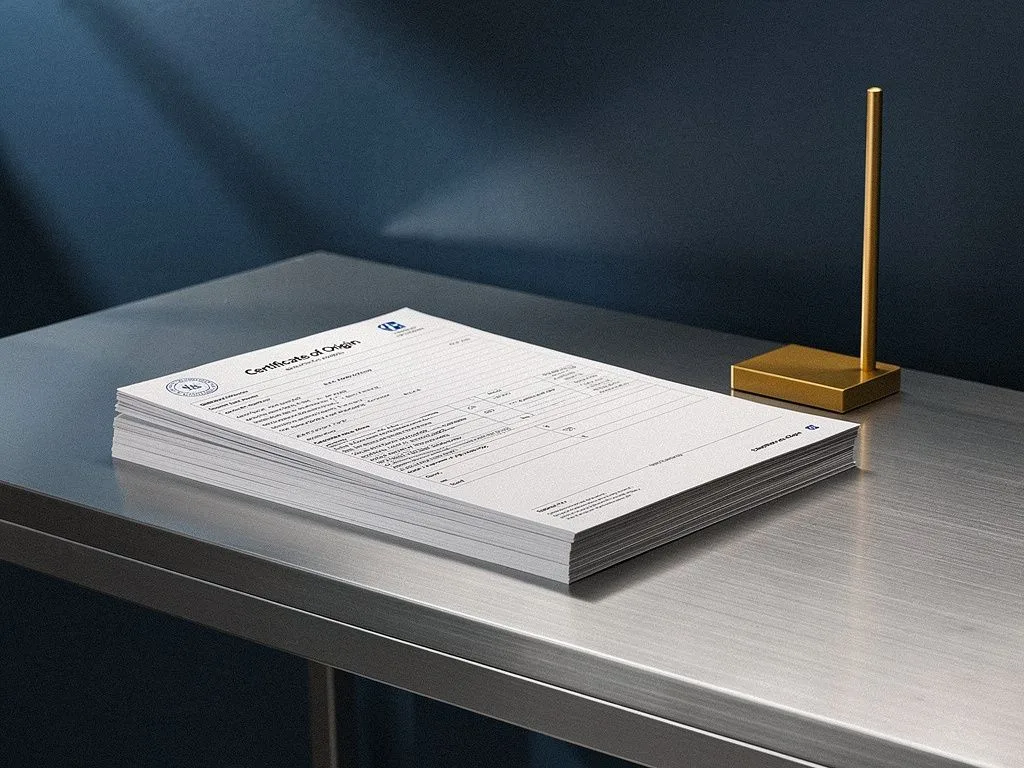
What export documents and certificates of origin do you need when sourcing CNC parts from Taiwan?
For buyers sourcing CNC machined parts from Taiwan, the most common question is: besides the parts themselves, what documents are required for smooth customs clearance and import? The basics include a commercial invoice, packing list, material certificate (MTC), and certificate of origin (Form E, a general certificate of origin, or an FTA preferential certificate of origin). For certain industries, inspection reports or export permits may also be required. Buyers are advised to provide the supplier with the destination country's import regulations, HS Code, and required documentation during the RFQ stage to avoid return shipment or document requests after arrival. Yuan Shun Li can provide invoices, packing lists, and material traceability data in the format specified by the customer to assist buyers with import declarations.
Key Takeaways
Four Essential Documents
Standard documents for exporting CNC parts from Taiwan include commercial invoice, packing list, material certificate, and certificate of origin. Missing any one may cause delays at the port of destination.
Certificate of Origin Type Depends on Trade Agreement
A general certificate of origin applies to countries without preferential agreements. Form E is the ECFA preferential certificate of origin, while FTA signatory countries require corresponding preferential formats, depending on the destination country.
MTC and Inspection Reports Are Critical
The material certificate records material grade and mechanical properties. Industries such as aerospace and medical additionally require third-party inspection reports or dimensional inspection sheets; formats must be confirmed before placing an order.
Export Permits Are Mostly Not Required
General industrial CNC parts do not require an export permit, but military-spec or strategic high-tech goods exported to controlled countries require an export license.
What is the basic document checklist for exporting CNC parts from Taiwan?
For CNC machined parts exported from Taiwan—whether turned parts, milled parts, or five-axis complex parts—the standard export documentation includes four basic items: a commercial invoice stating the product name, specifications, quantity, unit price, and total amount; a packing list indicating the net weight, gross weight, and piece count per carton; a material certificate (Mill Test Certificate / Material Certificate) specifying the material grade, chemical composition, and mechanical properties; and a certificate of origin proving that the goods were manufactured in Taiwan. These four documents are the basic requirements for customs in most countries, and missing any one of them can cause delays at the port of destination. Buyers are advised to inform the supplier of the destination country's language requirements (e.g., bilingual invoices) and the number of copies needed during the RFQ stage to avoid having to provide additional documents later. Yuan Shun Li can provide invoices and packing lists in the customer's specified format, and can also provide material traceability data upon request.
What types of certificates of origin are there? What is the difference between Form E and a general certificate of origin?
A certificate of origin is not just a single document; it comes in several types depending on the importing country and trade agreements. A general certificate of origin (C/O) is issued by the relevant authority in Taiwan and applies to countries without preferential agreements. Form E is the preferential certificate of origin under the Cross-Strait Economic Cooperation Framework Agreement (ECFA) between Taiwan and mainland China, which allows for reduced import tariffs. For exports to FTA signatory countries such as the EU, ASEAN, or New Zealand, the corresponding preferential certificate of origin (e.g., EAV, EUREP, ANZCERTA formats) must be applied for. The most common question from buyers is: "Which one applies to my country?" The answer depends on the destination country and whether an FTA is in place. Buyers are advised to first check the preferential certificate of origin format announced by the importing country's customs authority and to specify in the RFQ whether Form E or another FTA certificate is required; otherwise, the supplier will only apply for a general C/O by default.

What role do material certificates (MTC) and inspection reports play in CNC parts exports?
The material certificate (MTC) is one of the most underestimated documents in CNC parts exports, yet it is also one of the most frequently requested by customs and buyers. This document is issued by the material supplier or the machining facility and records the material grade, chemical composition, mechanical properties (tensile strength, hardness, elongation, etc.), and traceability batch number. Its purpose is to prove that the material used in the parts complies with the buyer's specified standards (e.g., SS400, A6061-T6, C3604). For industries such as aerospace, medical, and automotive Tier-1, an MTC alone is not sufficient; buyers typically also require third-party inspection reports or dimensional reports that record the measured values of critical dimensions and tolerance compliance. Yuan Shun Li performs dimensional inspections during the manufacturing process and before shipment, and can provide inspection data and material traceability information upon customer request. However, the specific format and number of copies must be confirmed before placing an order.

Six Practical Checkpoints for Export Documentation Preparation
Confirm the HS Code and import regulations of the destination country
Different countries classify CNC parts under different HS Codes and apply different tariff rates. Buyers should confirm the correct code and provide it to the supplier in advance to avoid misclassification that could lead to shipment rejection.
Notify the supplier in advance if a Form E or FTA preferential certificate of origin is required
Preferential certificates of origin must be applied for with the relevant authorities before shipment and cannot be issued retroactively. Buyers should clearly state this requirement at the RFQ stage.
Specify the language and number of copies for the invoice and packing list
Some customs authorities require invoices to be bilingual (Chinese/English) or in English only, and may require three or more original copies. Buyers should specify these requirements in advance.
Request a material test certificate (MTC) and specify the material standard
Buyers should indicate the material grade and standard (e.g., JIS, ASTM, EN) at the time of inquiry so the supplier can provide the correct MTC.
Confirm whether third-party inspection reports or notarization are required
Industries such as aerospace, medical, or those with high safety factors often require third-party inspection (SGS, BV, TÜV). Buyers should inform the supplier in advance and bear the associated costs.
Retain shipment samples and inspection records for at least five years
In the event of customs inspection or customer complaints after export, complete dimensional inspection records and material traceability data serve as the basis for response. It is recommended that both parties retain these records.
Do CNC parts require an export license? Under what circumstances are they controlled?
CNC machined parts are generally for civilian and industrial use and, in principle, do not require an export license to be shipped from Taiwan. However, there are two exceptions that require special attention. First, if the parts are of military specification or intended for defense purposes, even if they appear to be ordinary metal parts, an export license must be obtained in accordance with the relevant military goods export control regulations. Second, if the material is classified as a strategic high-tech commodity (e.g., certain aluminum alloys, titanium alloys, or composite materials) and is being exported to a country on the control list, an export license for strategic high-tech commodities may be required. For most OEM parts suppliers, Tier-1 subcontractors, and prototyping development teams, the CNC parts they procure are for general industrial use and do not require an export license. It is recommended that buyers proactively disclose the end use and the industry of the end customer at the time of inquiry, so the supplier can assess whether any controls apply and prepare accordingly.
Export Documentation Preparation Process
- 1
Confirm Import Regulations
The buyer confirms the HS Code, import regulations, and required certificates for the destination country, and provides them to the supplier during inquiry.
- 2
Communicate Certificate of Origin Needs
Inform in advance whether Form E or an FTA preferential certificate of origin is needed, as preferential certificates must be applied for before shipment and cannot be issued retroactively.
- 3
Specify Document Formats
Specify the language and number of copies for the invoice and packing list, as well as the material standard for the material certificate (e.g., JIS, ASTM, EN).
- 4
Confirm Inspection Requirements
Confirm whether third-party inspection reports or notarization are required. Industries such as aerospace and medical need to inform in advance and bear the costs.
- 5
Review Document Drafts
When receiving document drafts, check key fields such as amounts, product names, and country of origin item by item to avoid discovering issues only after arrival at the port.

How should buyers collaborate with Taiwanese suppliers to prepare export documents?
Export documentation is not the sole responsibility of the supplier; it is the result of collaboration between the buyer and the supplier. The most common issue buyers encounter is: "I provided the specifications, but the documents were incomplete upon arrival." This is usually because the two parties did not clearly agree on the document format, quantity, and language at the RFQ stage. It is recommended that buyers prepare an "Export Document Requirements Checklist" at the time of inquiry, specifying the destination country, HS Code, whether Form E or another FTA preferential certificate of origin is required, the invoice language and number of copies, the material standard for the MTC, whether third-party inspection reports are needed, and the end-use description. Upon receiving complete inquiry information, Yuan Shun Li can indicate the scope of documents it can provide in the quotation and prepare the invoice, packing list, and material traceability data in the customer's specified format before shipment, helping the buyer complete import declaration smoothly.
Remedies for export document errors and common pitfalls
The most common consequence of export document errors is not shipment rejection but delays and warehousing costs. Buyers often ask: "Can documents be corrected after arrival?" The answer depends on the type of error. Errors in key fields such as invoice amount, HS Code, or country of origin usually need to be corrected before arrival and the original documents reissued; otherwise, customs may hold the goods for inspection. If the packing list quantity does not match the actual arrival, a re-count within the warehouse must be arranged, and the responsible party bears the cost. Common pitfalls include: the invoice not stating the currency and trade terms (FOB, CIF, EXW, etc.), the certificate of origin not being applied for before shipment, the material grade on the material certificate not matching the actual material used, and the buyer's or consignee's business registration number or tax ID not being stated. It is recommended that buyers check each item on the document draft as soon as they receive it, especially the amount, product description, and country of origin, to avoid discovering problems only after arrival.
FAQ
What basic documents are needed to export CNC parts from Taiwan?
Basic documents include commercial invoice, packing list, material certificate (MTC), and certificate of origin. These four are basic requirements for most countries' customs; missing any one may cause delays at the port of destination. For specific industries, inspection reports or export permits may also be required.
Which type of certificate of origin applies to my country?
It depends on the destination country and whether an FTA is in place. A general certificate of origin applies to countries without preferential agreements. Form E is the ECFA preferential certificate of origin for cross-strait trade. For FTA signatory countries such as the EU, ASEAN, or New Zealand, the corresponding preferential certificate of origin format must be applied for.
What role does the material certificate (MTC) play in CNC parts export?
The material certificate is issued by the material supplier or machining factory, recording material grade, chemical composition, mechanical properties, and traceability batch number, proving that the part material meets the buyer's specified standards. Industries such as aerospace, medical, and automotive Tier-1 typically also require third-party inspection reports.
Is an export permit required for CNC parts export?
In principle, CNC parts for general civilian and industrial use do not require an export permit. However, if the parts are military-spec or for defense purposes, or if the material is classified as strategic high-tech goods and exported to countries on the control list, an export license is required.
Can export document errors be corrected after arrival at the port?
It depends on the type of error. Errors in key fields such as invoice amount, HS Code, or country of origin usually need to be corrected before arrival and original documents resent; otherwise, customs may hold the goods for inspection. If the packing list quantity does not match, a re-count at the warehouse may be required, with costs borne by the responsible party.
Need Quotation Support for Export Documentation and Certificates of Origin?
Please send your destination country, HS Code, whether Form E or other FTA preferential certificates of origin are required, invoice language and number of copies, and material specification requirements, along with part drawings, to [email protected], or call +886-4-2534-5219. The scope of available documentation and processing timelines will be confirmed based on the actual specifications.